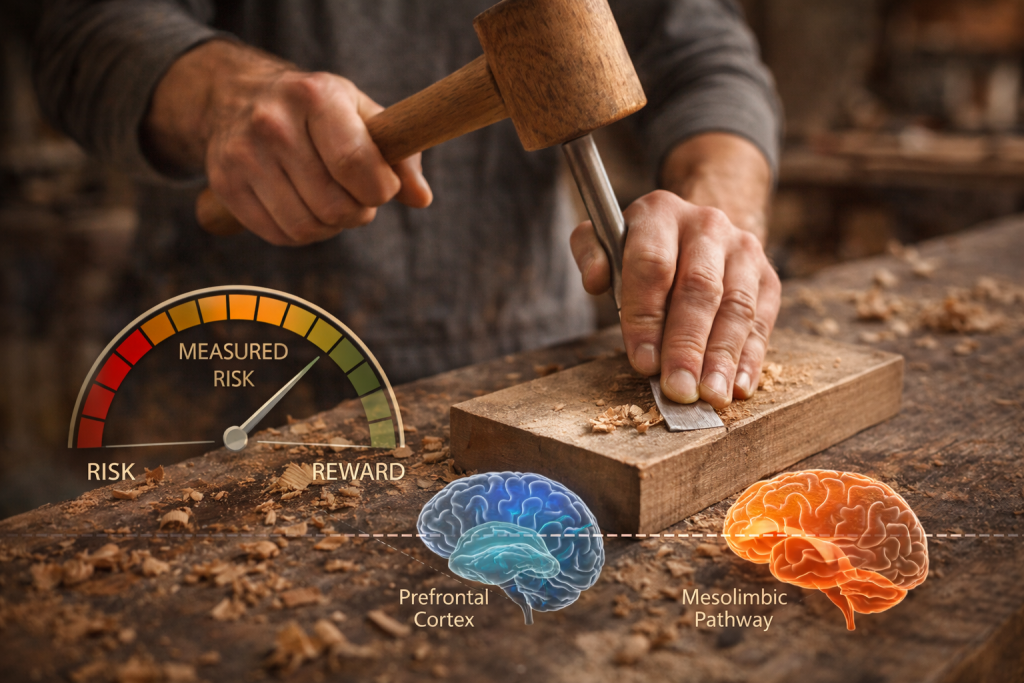
Growth requires manageable risk. Too much risk triggers shutdown. Too little produces boredom. The optimal zone is what psychologists call the “window of tolerance.”
Working with hand tools—whether carving knives, chisels, or precision brushes—places individuals in that optimal zone when instruction is structured properly. There is enough challenge to demand attention. There is enough safety structure to prevent overwhelm.
Using tools requires planning, coordination, and accountability. A tool responds directly to input. If pressure is uneven, the result reflects it. This feedback loop is immediate and honest. Cognitive-behavioral models highlight the importance of feedback in skill acquisition; accurate feedback accelerates learning and builds adaptive response.
At Ironwood, participants are taught tool literacy. They learn not only how to use tools but how to respect them. This fosters responsibility and internal locus of control. Instead of externalizing outcomes (“This isn’t working”), the participant adjusts technique (“My angle is off”).
This shift from external blame to internal adjustment builds psychological resilience.
There is also a physiological component. Novel but controlled challenge releases dopamine in moderate amounts. Dopamine is associated with motivation and reinforcement learning. When a person successfully completes a challenging task, the brain encodes it as rewarding.
Over time, participants begin associating effort with positive reinforcement rather than fear of failure.
Measured risk builds courage in increments. Ironwood’s teaching philosophy recognizes that confidence is not taught through affirmation. It is built through earned mastery in controlled environments.
Leave a Reply