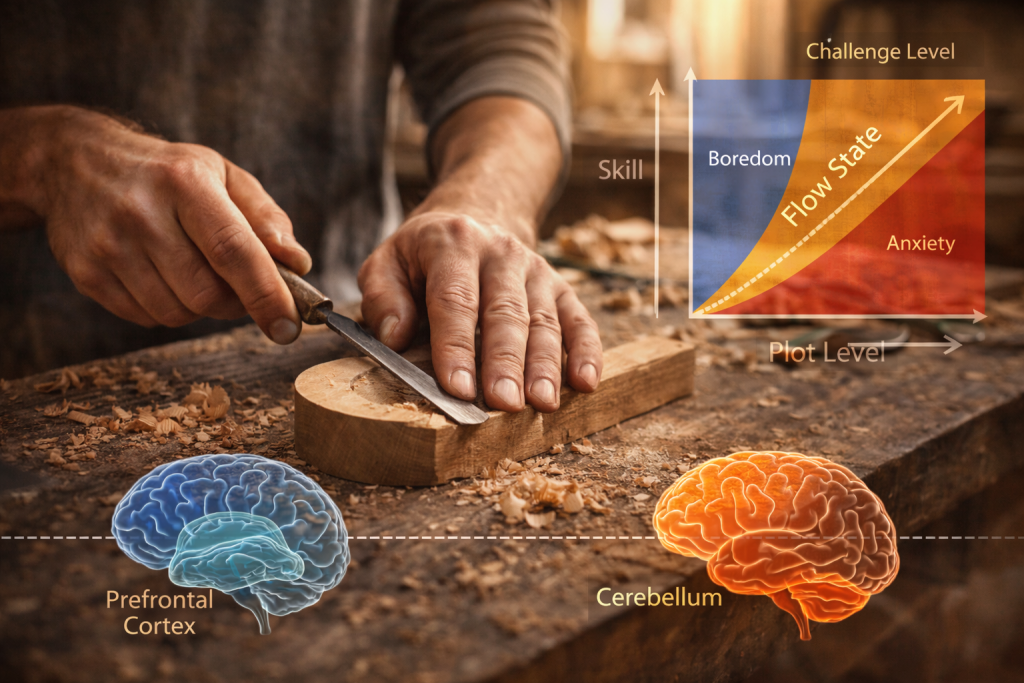
The concept of flow, described by psychologist Mihaly Csikszentmihalyi, refers to a state of deep immersion where skill and challenge are balanced. Time perception shifts. Self-consciousness decreases. Productivity increases.
Structured handcraft is particularly effective at inducing flow because it requires sustained attention, fine motor coordination, and real-time problem solving. When carving, for example, the brain tracks grain direction, pressure modulation, and micro-adjustments. This level of engagement narrows attentional bandwidth to the task at hand.
Functional MRI studies show that during flow states, activity in the medial prefrontal cortex decreases—a phenomenon called transient hypofrontality. This reduction corresponds with reduced self-criticism and internal narrative. Individuals often report feeling “outside their head.”
Ironwood teaches participants how to enter flow intentionally by calibrating challenge. Tasks are scaled to match skill level. Too simple, and attention drifts. Too complex, and anxiety rises. The instructor’s role is to adjust complexity so engagement remains steady.
Flow is not escapism. It is disciplined immersion.
Repeated experiences of flow strengthen attentional control. In a culture dominated by digital fragmentation, sustained focus is increasingly rare and increasingly valuable. Individuals who can regulate attention and persist through complexity are more adaptable in professional and personal environments.
Ironwood treats focus as a trainable capacity, not a personality trait.
Leave a Reply